Our Pets Deserve Wellness, Too.

Think of all the things that our pets do for us. They love us unconditionally; they teach us patience; they get us up and out of bed when we’re feeling unmotivated. Our family pets lower our cholesterol and our physiological indicators of stress, like blood pressure, cortisol and heart rate; they keep us active and more social; they improve our pain management; they reduce our feelings of fear and anxiety. The list goes on.

Family pets also aid in our children’s development. Kids with a family dog are less likely to have asthma, and they miss fewer days from school because of illness. And pets, especially dogs and cats, influence learning and cognition in children, and they help children develop self esteem and social skills. They provide children with companionship, sometimes even more so than siblings do. Most children consider their pet to be a member of the family, and many confide in their pets, believing their pets understand what they are going through.

We have very special relationships with our domesticated pets, and this special status is reflected in the way our brains respond to our furry friends. Petting your dog increases oxytocin, prolactin, phenylacetic acid and dopamine; the effect is reduced when you pet a strange dog. These biological substances are neurotransmitters and hormones associated with affiliation and reward. In fact, the pattern of your brain activity when viewing your pet is very similar to the pattern seen when viewing your child.  When pet owners claim that their dog is a member of the family, this is no exaggeration.

So, when you consider everything your family pet does for you, don’t you think your pet deserves the best that you can offer?

https://www.localfirst40.com/

Beetz A, et al. Psychosocial and Psychophysiological Effects of Human-Animal Interactions: The Possible Role of Oxytocin. Frontiers in Psychology (2012). doi:10.3389/fpsyg.2012.00234.

Levine GN, et al. Pet Ownership and Cardiovascular Risk. Circulation (2013). doi.org/10.1161/CIR.0b013e31829201e1

Purewal R, et al. Companion Animals and Child/Adolescent Development: A Systematic Review of the Evidence. International Journal of Environmental Research and Public Health (2017). DOI: 10.3390/ijerph14030234

Stoeckel LE, et al. Patterns of Brain Activation when Mothers View Their Own Child and Dog: An fMRI Study. PLOS ONE (2014). doi: 10.1371/journal.pone.0107205

Understanding the Dynamic Nature of Cortisol

I was speaking with a client yesterday morning, and was surprised by her misunderstanding of the stress hormone cortisol. Yes, cortisol is elevated when we are stressed; and, Yes, having chronically elevated cortisol is destructive to the brain and body. However, cortisol is also elevated when we are excited, happy, joyful, and surprised.

For example, think back on a memorable dinner you had a number of years ago. Why do you remember what you ate during this distant meal, but probably don’t remember what you had for lunch two weeks ago? The reason, at least in part, is your cortisol was elevated during the memorable dinner in conjunction with your elevated – presumably positive – emotional state.

So what differentiates “bad” cortisol from “good” cortisol elevation?

Cortisol is part of a dynamic physiological system that evolved to help us remember, and learn from, important events. Elevated cortisol is particularly important when you experience negative events because it facilitates 1) emotional memory consolidation and 2) attention toward emotional information. This was important to our ancestors for dealing with threats in the environment, and for remembering rewarding events.

amygdala-crh-mrna-figure
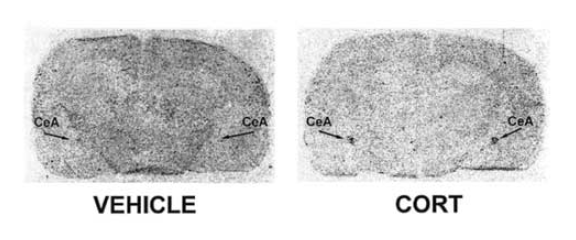
Administering corticosterone (CORT; the rat version of cortisol) causes physiological changes in rat amygdala (CeA).

It is cortisol’s effects on neuropeptides like corticotrophin-releasing hormone (CRH) in the amygdala that allows us to effectively encode memories. The digitized images above show that CRH messenger RNA (mRNA) is increased in the central amygdala (CeA) when corticosterone (the equivalent of cortisol in rats) is administered to rats. The cort-treated rats showed enhanced emoional memory in conjunction with the changes in the amygdala (Thompson, Erickson et al., 2004).

So the problem isn’t when cortisol is periodically elevated in response to emotional (negative or positive) situations; this is adaptive and healthy. Our cortisol levels are constantly in flux when we are healthy. The problem is when cortisol is chronically elevated. Chronic cortisol elevation is associated with a number of physical and mental health conditions, and when we are under constant stress our cortisol doesn’t necessarily follow the normal adaptive patterns.

Your cortisol levels may be chronically elevated due to stress if you experience weight gain, obesity, fatigue, difficulty concentrating, insomnia, irritability, and a number of other symptoms. If you live in a constant state of stress, some relaxation techniques might be helpful, especially if you are experiencing some of these symptoms. Breathing techniques, meditation and muscle relaxation are options that are available to everyone. Listening to music, exercise, and making healthy adjustments to your diet also help reduce stress. Find what you love and make time for it. Make your wellness a priority.

Visit me on the web at Inspired-HealthWellness.com; on Facebook; on Instagram; or LinkedIn.


The Overfat Epidemic

Body fat

In case you needed another reason to start exercising, I was just introduced to the concept of “overfat” which, as a wellness coach and personal trainer, resonates with me. According to an article just published in the journal Frontiers in Public Health, up to 76% of the world population is overfat (1). This group of people includes those who are NOT overweight or obese according to standard height-vs-weight measurements, but still have an unhealthy amount of body fat that threatens their health.

In other words, in addition to the almost 50% of overweight and obese people on the planet, there are as many as 25% additional individuals who have excess unhealthy body fat, even though their weight-to-height ratio is within the healthy range. That’s a total of 5 billion people who need to burn excess fat. 

Percent of the world population estimated to be overfat.

Body fat can be measured using calipers. Skin folds are measured across standardized areas and used to calculate the percentage of body fat in your body. It is difficult to do this type of measurement on yourself, but if you have an experienced examiner it is very reliable. Bioelectrical impedance analysis (BIA) is another option, and can be done on your own using a scale that calculates body fat or with a handheld BIA device. The downside to this option is less accuracy because it relies on water content in your body to estimate body fat.

The overfat concept resonates with me because I often see people whose BMI (body mass index) is below 25 — the magic number to not exceed according to the CDC (Center for Disease Control) — but who are not happy with their bodies. Increasing muscle mass helps to increase metabolism and, consequently, burn fat more efficiently. A side effect of weight training to build muscle is that bone density is positively affected as well.

So what are you waiting for? Exercise and healthy eating will make a difference, reducing the threat of lifestyle-related disease, increasing energy, reducing stress, and improving overall well-being!


  1. Philip B. Maffetone, Ivan Rivera-Dominguez, Paul B. Laursen. Overfat and Underfat: New Terms and Definitions Long Overdue. Frontiers in Public Health, 2017; 4 DOI: 10.3389/fpubh.2016.00279

Walking the Labyrinth

I went for a bike ride today and found myself at a labyrinth. I’ve known of this labyrinth for a while now, but this was the first time I had stopped and given it much attention. The idea of walking a labyrinth appealed to me, as I am continuously working on finding peace and calm, so I can bring that grounded feeling into my home and share it with those around me.

Labyrinths have been around for thousands of years, the best-known early examples are associated with the Minotaur legend on the island of Knossos. The labyrinth was used by Catholic monks as a tool for meditation and contemplation during the medieval period. Today labyrinths are everywhere, in some surprising places. A 25-mile radius search around my home outside of Washington, DC found 44 labyrinths. Most are located at churches (of all denominations) but others are located in parks, at private residences, at places of learning, places of healing, and professional health organizations (e.g., University of Maryland, Walter Reed National Military Medical Center, American Psychological Association).

So what was my experience with walking the labyrinth for the first time? It took much longer than I expected, and now I understand how this is a calming, meditative, and healing practice. I felt my mind quiet as I paced, step by step, along the twisting and spiraling pathway to the center of the labyrinth. My vision was reduced to the few feet in front of me, sounds of passing cars receded into the background, and my mind became focused on the present as I let go of all thoughts about the future. I was surprised at how effective it was at bringing me into a calm and peaceful state.

Next time, I will come to the labyrinth prepared for its quiet power. 

Optimism

op·ti·mism /ˈäptəˌmizəm/
noun

1. Hopefulness and confidence about the future or the successful outcome of something.

2. Philosophy: The doctrine, especially as set forth by Leibniz, that this world is the best of all possible worlds.

2.1. The belief that good must ultimately prevail over evil in the universe.

~ Oxford English Dictionary


Improving your optimistic outlook on life may be the key to reduced anxiety. Anxiety can be overwhelming. I know that when I feel anxious, it is difficult to be optimistic, but through conscious effort, practicing techniques I have picked up over the years, I can influence my optimism and manage my anxiety.  Sounds simple, right? Rather than letting anxiety overwhelm you, use positive thoughts to overwhelm and run off the anxiety.

Optimism refers to positive expectations for the future.

Now, an area of the brain, part of the prefrontal cortex, is identified as important for the association between optimism and anxiety. The prefrontal cortex can be divided into subregions, one of which is the orbitofrontal cortex (OFC). The OFC rests above the eye sockets and is relatively well protected from injury. This is in contrast to the dorsolateral prefrontal cortex, which lies beneath the front part of your skull and is responsible for planning, logical reasoning and other related tasks. The OFC is critical for emotional regulation and personality, and damage to OFC results in a range of emotional, social and personality changes.

A study by Dolcos et al (2015) at the University of Illinois, appearing in Social Cognitive Affective Neuroscience, reports thicker gray matter in the left OFC is associated with greater trait optimism, and that this optimism can protect against anxiety symptoms. What is the functional significance of this greater thickness? How it mediates optimism and anxiety is unclear. As with most things, when speaking of the brain, more doesn’t necessarily mean better, but in this case more gray matter is beneficial. Is there hope for those who don’t have an optimistic outlook, and have relatively thinner left OFC gray matter? This may be addressed by future studies. We know the brain is plastic, and each time we have a new experience or learn something new changes take place, in the form of new growth or shrinkage, new connections made or old connections weakened.

The left OFC has connections with the amygdala, a structure important for the perception of emotionally provocative information, especially novel and threatening stimuli. Stimulation of the amygdala leads to fear and anxiety behaviors in animals. What is especially interesting is activation of the left OFC leads to suppression of amygdala activation; this may be relevant to the associations found by Dolcos and colleagues. Perhaps those with more gray matter volume in the this region are better able to regulate their anxiety through this interaction between the OFC and the amygdala, and the increased optimism can be seen as the driving force behind this.

“The optimist proclaims that we live in the best of all possible worlds; and the pessimist fears this is true.”

~ James Branch Cabell

Increasing your optimism has many potential benefits. Trait anxiety and optimism are both correlated with quality of life in the expected directions, with lower anxiety and higher optimism associated with a better quality of life. Optimism is good for your heart; it helps cardiac patients heal after surgery, and those who are optimistic tend to have lower blood pressure than those who are pessimists. Optimism is also associated with better overall health and survival rates. Optimism is a universal phenomenon, and is associated with better wellbeing across a number of cultures.

Dolcos S, Hu Y, Iordan AD, Moore M, Dolcos F. Optimism and the brain: trait
optimism mediates the protective role of the orbitofrontal cortex gray matter
volume against anxiety. Soc Cogn Affect Neurosci. 2015 Sep 14. pii: nsv106. [Epub
ahead of print] PubMed PMID: 26371336.